 how-to
Why Do Dark Spots Fade So Slowly?
Last Updated: October 30, 2026
Quick Summary
Dark spots fade slowly because the pigment sits inside living skin cells, and your body clears it at its own pace. Melanin trapped in the deeper layers must travel up through several rounds of cell turnover before it disappears, and each cycle takes weeks. Depth is the single best predictor of how long a spot will take to clear.
- Keratinocyte transit time from the base of the epidermis to the surface typically takes about four weeks in healthy skin.
- Epidermal pigment often softens within weeks to a few months, while dermal pigment may persist for many months or longer.
- Many people see visible change in six to twelve weeks with consistent care.
- Sunlight reactivates melanocytes, and even brief daily exposure without protection can undo weeks of progress.
- Photograph your face in the same light, at the same time, once a week to track progress.
Table of Contents
- The Skin-Renewal Process Behind Slow-Fading Dark Spots
- How Long Does It Take to Fade Dark Spots?
- Why Are My Dark Spots Not Going Away?
- How Spot Type, Depth, and Skin Tone Change the Timeline
- How to Fade Dark Spots on Face: A Week-by-Week Tracking Guide
- Ingredients for Hyperpigmentation That Support Faster Fading
- When a Changing Dark Spot Needs Medical Assessment
- Building a Fading Routine With Clear Essence®
- Frequently Asked Questions
The Skin-Renewal Process Behind Slow-Fading Dark Spots
Dark spots fade slowly because the pigment sits inside living skin cells, and your body clears it at its own pace. Dark spots are not surface stains you can scrub off.
Your skin sheds its outer layer constantly. New cells push up from below, and old pigmented cells flake away. That cycle takes weeks, not days. When extra melanin gets trapped in the deeper layers, it has to travel up through several rounds of cell turnover before it disappears.
How Melanin Gets Trapped in the Skin
Melanin is the pigment that gives skin its color. When skin gets injured or stressed, cells called melanocytes overproduce it as a defense. The excess pigment is packaged into tiny parcels called melanosomes and handed off to nearby keratinocytes, the cells that make up the bulk of the epidermis. Those pigment-loaded keratinocytes do not vanish. They get pushed upward as the skin renews itself.
The key number is keratinocyte transit time: the trip from the base of the epidermis to the surface typically takes about four weeks in healthy skin, and it slows with age and sun damage. A single renewal cycle can take several weeks. Pigment that settled deep needs multiple cycles to surface. That is why a spot you can see today may have been forming for months.
Epidermal vs. Dermal Pigment: Why Depth Decides the Timeline
Not all pigment sits at the same depth, and depth is the single best predictor of how long a spot will take to clear.
- Epidermal pigment sits in the upper layers. Because those cells are already on their way out, epidermal marks respond fastest to topical care and often soften within weeks to a few months.
- Dermal pigment sits below the epidermis, in the dermis. Keratinocytes do not carry it upward, so it clears far more slowly and may persist for many months or longer. Some dermal pigment is never fully removed by topicals alone.
- Mixed pigment has both components, which is common in melasma and in deeper post-inflammatory marks. The epidermal portion responds first; the dermal portion lags.
This is why two people can use the same serum for the same length of time and see very different results. The product is not necessarily working differently; the pigment is simply sitting at a different depth.
Why Melanin-Rich Skin Holds Pigment Longer
Melanocytes in melanin-rich skin are more active. They respond faster and stronger to sun, injury, and inflammation. That is protective in many ways, but it also means pigment lingers.
The same trigger that causes a mild mark on lighter skin can leave a deeper, longer-lasting mark on deeper skin tones. For a fuller look at safe lightening methods, see our guide to natural skin lightening for Black skin and multicultural tones.
How Long Does It Take to Fade Dark Spots?
Expect several weeks to several months, depending on the spot. Many people see visible change in six to twelve weeks with consistent care. Stubborn marks can take longer.
The honest answer: how long it takes to fade dark spots depends on depth, cause, and how well you protect your skin. A published study on a targeted pigment-correcting product reported meaningful improvement in skin-tone evenness over a 12-week period (12-week pigment study).
Why Are My Dark Spots Not Going Away?
If your dark spots are not going away, something is still feeding them. Pigment does not fade while the trigger stays active. Most slow-fading cases come down to two culprits: ongoing sun exposure and irritation from the treatment itself.
Ongoing UV Exposure and Daily Sun Protection
Sunlight reactivates melanocytes. Even brief daily exposure without protection can undo weeks of progress. This is the single biggest reason spots stall.
Daily sunscreen is not optional here. Use a broad-spectrum formula every morning, reapply when you are outside, and wear a hat. If you need a place to start, browse our sun protection products. Protecting skin is half the treatment.
Treatment Irritation That Makes Pigmentation Worse
Aggressive scrubs, strong acids, and over-exfoliating can backfire. Irritation triggers more melanin, which means darker marks instead of lighter ones.
Watch out: layering too many actives at once is a common mistake. It inflames the skin barrier and deepens pigmentation. If your skin is already irritated or sunburned, follow steps to soothe and restore sunburned skin before restarting any fading product.
How Spot Type, Depth, and Skin Tone Change the Timeline
Not all spots behave the same. Type and depth decide how fast pigment clears, and skin tone affects how strongly melanocytes respond.
| Spot Type | Typical Cause | Depth | Expected Pace |
|---|---|---|---|
| Acne marks | Post-inflammatory response | Surface to mid | Weeks to a few months |
| Sun spots | UV exposure | Mid-layer | Months |
| Melasma | Hormonal changes | Deeper | Many months, needs sun control |
| Age spots | Sun plus skin aging | Mid to deep | Slow, often months |
Deeper pigment simply has more distance to travel. Deeper skin tones also carry more active melanin, so marks persist longer. Neither fact means the spot is permanent.
How to Fade Dark Spots on Face: A Week-by-Week Tracking Guide
You cannot judge progress by memory. Track it. Photograph your face in the same light, at the same time, once a week. Then follow this rhythm.
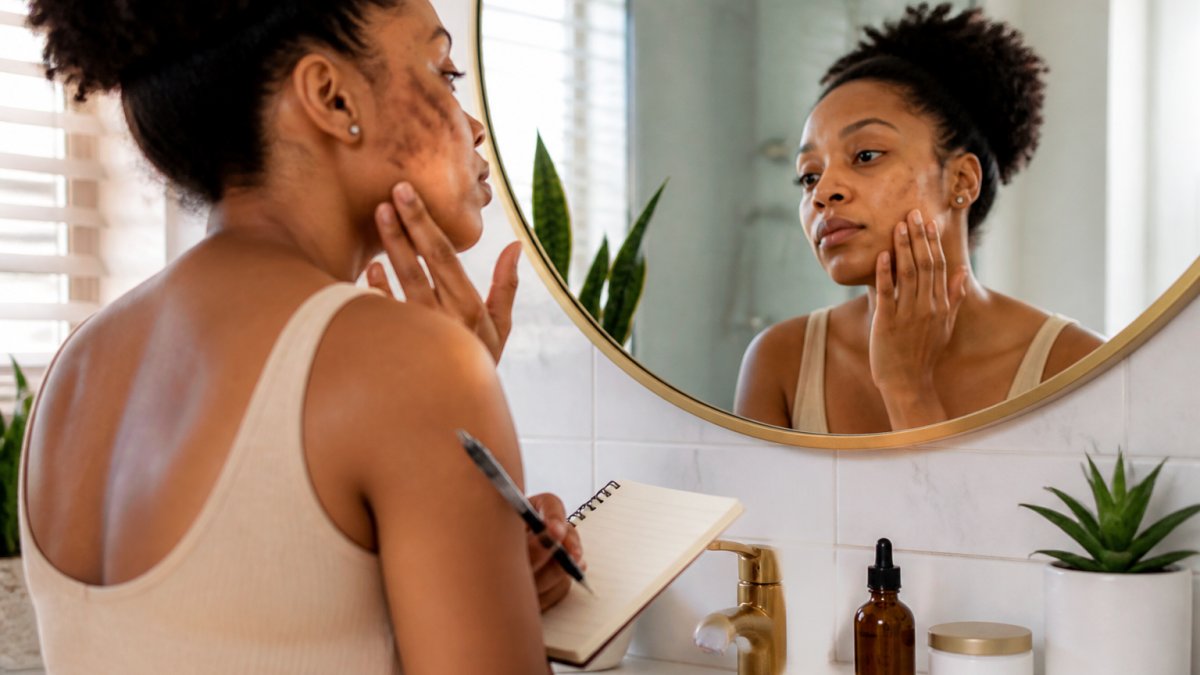
- Weeks 1-2: Build the habit. Cleanse gently, moisturize, apply sunscreen daily. No results yet, and that is normal.
- Weeks 3-4: Add one brightening product. Keep everything else steady.
- Weeks 5-8: Expect early softening at the edges. Take weekly photos.
- Weeks 9-12: Compare photos side by side. Most people see real change here.
If a spot has not budged after three months of consistent care, that is your signal to reassess, not to give up.
Ingredients for Hyperpigmentation That Support Faster Fading
The right ingredients for hyperpigmentation support your skin's own clearing process. They do not bleach or strip. Look for:
Pair these with a targeted treatment. Start with one active, patch test it, and give it weeks before judging.
When a Changing Dark Spot Needs Medical Assessment
Most dark spots are cosmetic. They are annoying, they fade slowly, and they are not dangerous. But a small share of pigmented lesions are something else, and the difference matters.
The practical rule: stable spots can wait; changing spots should not. A spot that has looked the same for months is very unlikely to be a medical emergency. A spot that is evolving is a different signal.
Cosmetic Pigmentation vs. a Spot That Needs a Doctor
Cosmetic pigmentation, including post-acne marks, sun spots, melasma, and age spots, tends to be:
- Stable in shape, color, and size over weeks
- Symmetrical or gradually softening at the edges
- Flat or only slightly raised
- Not itchy, painful, or bleeding
A spot that warrants prompt clinical evaluation often shows one or more of the following, sometimes summarized by clinicians as the ABCDE signs:
- A for asymmetry: one half does not match the other
- B for border: edges that are irregular, ragged, or blurred
- C for color: uneven color, or multiple shades within one spot
- D for diameter: larger than a pencil eraser (about 6 mm), though some serious lesions are smaller (the American Academy of Dermatology)
- E for evolving: any change in size, shape, color, or symptoms
Symptoms That Should Prompt a Call, Not a Serum
See a dermatologist promptly if a spot:
- Grows or changes quickly
- Has uneven or multiple colors
- Bleeds, itches, or hurts
- Appears new and unusual, especially after age 30
- Sits on a nail, palm, sole, or mucous membrane, where pigment behaves differently
People with a personal or family history of skin cancer, many moles, or a history of significant sun exposure or tanning-bed use should be evaluated sooner rather than later. A dermatologist can examine a spot in minutes and, if needed, biopsy it.
Do not start a brightening product on a spot that is changing, bleeding, or new. Get the spot checked first, then treat the cosmetic pigmentation once you have the all-clear.
Fading is slow, but change is a different signal. Get it looked at.
Building a Fading Routine With Clear Essence®
Consistency beats intensity. A simple routine you follow daily will outperform an aggressive one you abandon.
Our approach for melanin-rich skin:
- Morning: gentle cleanse, moisturizer, broad-spectrum sunscreen
- Evening: cleanse, then one brightening treatment
- Weekly: one gentle exfoliation, no more
- Always: hydrate dry, sensitive skin deeply
Clear Essence® offers dermatologist-tested formulas made for melanin-rich skin. Take a look at our Exclusive Medicated Fade Creme as a core treatment to add to your routine.
Frequently Asked Questions
Why do dark spots take so long to fade?
Dark spots fade at the speed of your skin's renewal cycle, not the speed of your serum. Melanin produced after sun exposure or inflammation sits in cells deeper than the surface layer, so it has to move up through the skin before it can shed. A full cycle runs about 28 days in younger skin and lengthens with age, which is why visible change typically takes weeks to months. A 2023 12-week study of a pigment-correcting product found significant improvement in skin-tone evenness, which shows steady use over months is the realistic benchmark.
Can sun exposure make dark spots last longer?
Yes. UV exposure tells pigment cells to produce more melanin, so a spot you are trying to fade gets refilled faster than your skin can clear it. Daily broad-spectrum sunscreen is the single habit that protects the progress you have already made. Without it, a fading routine can look like it is doing nothing, because new pigment keeps arriving. Reapply during long outdoor time, and remember that visible light also drives melasma, so tinted or iron-oxide formulas help if melasma is your concern.
How long does it take to fade dark spots on the face?
Post-inflammatory marks from acne or a rash often fade in 3 to 24 months on their own, with most improving noticeably within several months of consistent care. Sun spots and age spots respond more slowly because the pigment is deeper. Melasma is the most stubborn and often needs ongoing management rather than a finish line. Your spot type, depth, and skin tone all shift the timeline, so track photos every two weeks instead of judging progress daily.
When should I see a dermatologist about a dark spot?
Book an appointment if a spot is new, changing in size, shape, or color, has irregular borders, or sits alongside bleeding or itching. A spot that looks like ordinary pigmentation should be checked before you treat it as cosmetic, because fading creams can mask an early melanoma. A board-certified dermatologist can also confirm whether you are dealing with melasma, post-inflammatory hyperpigmentation, or something else, which changes which ingredients for hyperpigmentation make sense for your skin.
Dark spots fade slowly, and that is normal. The fix is patience plus protection, not a stronger product. Clear Essence® makes dermatologist-tested, cruelty-free formulas built for melanin-rich skin, with targeted treatments to fade dark spots, even skin tone, and keep skin deeply hydrated. Get started with Clear Essence® and give your skin the time and care it needs to fade.