 how-to
7 Ways to Prevent Razor Bumps on Black Skin
Last Updated: October 26, 2026
Quick Summary
To prevent razor bumps, soften your hair with a warm shower or towel for 2-3 minutes, shave with the grain using light pressure, and stop after one or two passes. Rinse with cool water, pat dry, and moisturize while skin is still damp.
- Razor bumps appear 24-72 hours after shaving and often contain a visible trapped hair.
- Use a guard length of 1 mm or longer with clippers to keep hair tips from re-entering skin.
- Exfoliate gently two to three times a week with salicylic or glycolic acid, never on inflamed skin.
- Apply broad-spectrum SPF 30 or higher daily to keep dark spots from darkening and slowing fading.
- Razor bumps usually clear in 3 to 7 days if you stop shaving the area and let hair grow out.
Table of Contents
- Why Curly Hair Makes Razor Bumps on Black Skin So Common
- How to Shave to Prevent Razor Bumps: A Step-by-Step Routine
- The Best Razor for Preventing Ingrown Hairs and Irritation
- Exfoliation and Aftercare That Clear Clogged Follicles
- Razor Bumps and Hyperpigmentation: Stopping Dark Spots Early
- How Long Do Razor Bumps Last and When to See a Dermatologist
- Building Your Razor Bump Prevention Kit with Clear Essence
- Frequently Asked Questions
Why Curly Hair Makes Razor Bumps on Black Skin So Common
Razor bumps are inflamed bumps that form when a cut hair curls back and grows into the skin.
The numbers are stark. According to Black Health's reporting on a 2024 study, 43.7% of 655 police recruits of African descent who were required to shave weekly developed pseudofolliculitis barbae.
Below, we break down the habits that actually reduce bumps, and the ones that quietly make them worse.
How a Hair Grows Back Into the Skin
Pseudofolliculitis barbae (PFB) is an inflammatory condition where shaved hair re-enters the skin and triggers papules and pustules. The mechanism is simple: tightly curled hair has a natural arc.
Your body treats that as an injury. Redness, itching, and painful bumps follow.
Coarse hair makes it worse. A thicker strand has more force behind it, so it pushes back into the skin more easily than fine hair does.
Razor Bumps or Something Else? Telling PFB Apart
Not every bump on your jaw is a razor bump. Getting the diagnosis right changes what you do next.
Here is how the common look-alikes differ:
- PFB: Bumps appear only where you shave, usually 24-72 hours later, and often contain a visible trapped hair.
- Acne: Can appear anywhere, including areas you never shave, and often has whiteheads or blackheads.
- Folliculitis: Bacterial or fungal infection of the follicle, usually with pus and spreading warmth.
If bumps spread beyond your beard area or feel hot to the touch, that points to infection, not PFB. See a doctor.
How to Shave to Prevent Razor Bumps: A Step-by-Step Routine
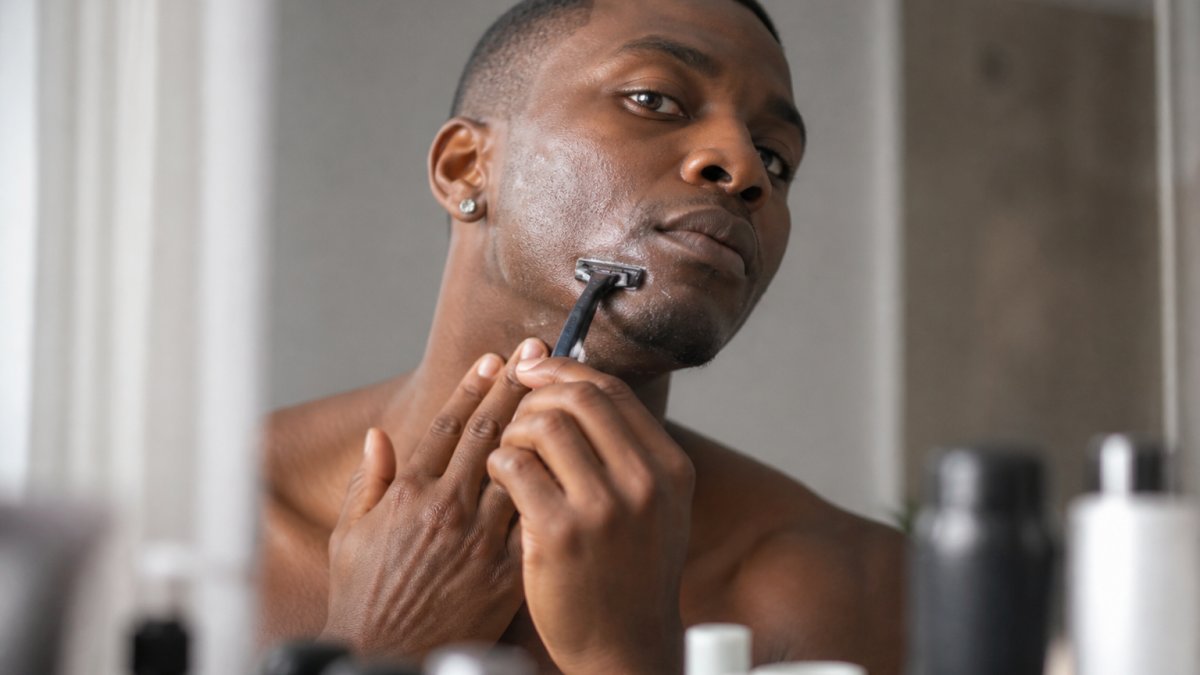
The best way to shave to prevent razor bumps is to soften the hair first, shave with the grain using light pressure, and stop after one pass. Most bumps come from rushing the prep or pressing too hard, not from the razor itself.

Prep, Shave, and Rinse in the Right Order
Follow this sequence every time:
- Soak the beard. Shower first or hold a warm, damp towel to your face for 2-3 minutes. Soft hair cuts cleanly and springs back less.
- Cleanse gently. Use a mild wash to lift oil and debris from the follicle opening.
- Apply shave gel. Let it sit 30 seconds so it cushions the blade.
- Shave with the grain. Follow the direction the hair grows, never against it.
- Use light pressure and fewer passes. One pass, two at most. Do not go over the same spot repeatedly.
- Rinse with cool water. Cold water calms inflammation and closes the follicle opening.
- Pat dry, don't rub. Friction on freshly shaved skin invites irritation.
- Moisturize. Seal the skin barrier while it is still slightly damp.
Follow this sequence every time you shave to cut down on irritation and bumps.
| Step | What to do | Time or frequency |
|---|---|---|
| Soak the beard | Shower first or hold a warm, damp towel to your face | 2-3 minutes |
| Cleanse gently | Use a mild wash to lift oil and debris | Every shave |
| Apply shave gel | Let it sit so it cushions the blade | 30 seconds |
| Shave with the grain | Follow hair direction, never against it | One pass, two at most |
| Rinse with cool water | Calms inflammation and closes the follicle opening | After shaving |
| Pat dry, don't rub | Avoid friction on freshly shaved skin | After rinsing |
| Moisturize | Seal the skin barrier while still slightly damp | After patting dry |
The Best Razor for Preventing Ingrown Hairs and Irritation
There is no single best razor for every face. The right tool depends on how close you need to get, how sensitive your skin is, and how much time you will actually spend on prep. What matters most is matching the tool to your hair texture and using it correctly.
Here is how the main options compare on closeness, irritation risk, and technique.
Single-Blade Safety Razor
- Closeness: High, but you control the angle.
- Irritation risk: Low to moderate when used with light pressure.
- Technique: Hold the razor at roughly a 30-degree angle, use short strokes, and let the blade do the work. Rinse the blade after every stroke. Change blades after three to five shaves, or sooner if it drags.
Electric Foil or Rotary Shaver
- Closeness: Moderate. It cuts hair at or just above the skin line, so the tip is less likely to curl back in.
- Irritation risk: Lowest for most people with PFB.
- Technique: Use small circular motions with a rotary shaver or short straight passes with a foil shaver. Do not press hard. Clean the head weekly and replace cutters per the manufacturer's schedule.
Clippers With a Guard
- Closeness: Low. A guard leaves a visible layer of hair, which is often enough to prevent the hair tip from re-entering the skin.
- Irritation risk: Very low.
- Technique: Use a guard length of 1 mm or longer, keep the blade clean, and avoid pressing the corner of the blade into the skin. This is the approach many dermatologists suggest when a patient must shave for work but keeps developing bumps.
Multiblade Cartridge
- Closeness: Highest.
- Irritation risk: Highest for tightly coiled hair, because the first blade lifts the hair and later blades cut it below the skin line.
- Technique: If you use one, shave with the grain only, stop after one pass, and pair it with preshave hydration and post-shave moisturizer. A 2025 review in PubMed Central's analysis of PFB management found that multiblade razors used with good prep and aftercare do not worsen PFB, so blade count matters less than the routine around it.
Whichever tool you choose, the blade or cutter should be sharp and clean. A dull blade tugs hair and forces you to press harder, which is a common path to irritation. If you prefer a cartridge, pair it with a shave gel built for bump control and skip the against-the-grain pass entirely.
Exfoliation and Aftercare That Clear Clogged Follicles
Exfoliation removes the dead skin that traps hairs at the follicle opening. Do it gently, two to three times a week, and never on raw or inflamed skin.
Chemical exfoliants beat scrubs here. A wash with salicylic acid or glycolic acid dissolves the plug without the friction that physical scrubs create.
- Salicylic acid: oil-soluble, good for oily skin and clogged pores.
- Glycolic acid: an AHA that resurfaces the top layer, best for rough texture.
- Benzoyl peroxide: useful when bacteria are part of the problem, but drying.
Apply moisturizer within three minutes of patting dry. You can also browse natural body soaps suited to clogged follicles.
Razor Bumps and Hyperpigmentation: Stopping Dark Spots Early
Every inflamed razor bump can heal into a dark spot. On darker skin, post-inflammatory hyperpigmentation (PIH) is often the longest-lasting part of the problem: the bump may fade in a week, but the mark can linger for months. The goal is to prevent the bump first, then prevent the mark from forming, and only then treat marks that already exist.
Step 1: Prevent the Bump
Fewer bumps mean fewer spots. The shaving routine and tool choices above are the foundation. If you keep shaving over irritated skin, no brightening ingredient will keep up.
Step 2: Prevent the Mark From Forming
When a bump does appear, calm it quickly and protect the skin from anything that darkens pigment.
- Do not pick or squeeze. Trauma to the skin increases pigment production.
- Use a cool compress for a few minutes to reduce swelling.
- Apply a barrier moisturizer while the skin is still slightly damp.
Step 3: Treat Marks That Have Already Formed
Introduce one active at a time, and give each four to six weeks before adding another. This makes it easier to tell what works and what irritates your skin.
- Niacinamide: Gentle, well tolerated by most skin types. It supports the skin barrier and helps even tone. A common starting point is a 4% to 5% formula used once daily.
- Azelaic acid: Available over the counter at 10% or by prescription at higher strengths. It targets pigment and inflammation and is often better tolerated than stronger acids.
- Retinoids: Speed cell turnover and can help fade marks, but they can also irritate skin and cause temporary dryness. Start with a low-strength over-the-counter retinoid two nights a week, and build up slowly. Do not use a retinoid on raw or broken skin.
A Realistic Timeline
PIH fades slowly. Most people see gradual improvement over eight to twelve weeks with consistent sun protection and one or two well-tolerated actives. If marks are unchanged after three months of consistent care, a dermatologist can discuss prescription options.
Our Dark Spots guide covers a fuller treatment plan for stubborn marks.
How Long Do Razor Bumps Last and When to See a Dermatologist
Razor bumps usually clear in 3 to 7 days if you stop shaving the area and let the hair grow out. Larger, deeper bumps can take two to four weeks.
Speed things up with a warm compress to soften the trapped hair, then a cold compress to reduce swelling. Do not pick or squeeze.
See a dermatologist if you notice:
- Bumps that persist beyond four weeks
- Signs of infection: spreading redness, warmth, pus
- Keloid-like scarring
Prescription retinoids or antibiotics may be needed for stubborn cases.
Building Your Razor Bump Prevention Kit with Clear Essence
A prevention kit beats a single product. Ours centers on four steps: cleanse, shave with gel, exfoliate gently, and moisturize daily.
The full Clear Essence ChiMere Line offers dermatologist-tested, cruelty-free formulas made for melanin-rich skin. Pair it with the routine above, and expect visible improvement in a few weeks, not overnight.
Frequently Asked Questions
Are razor bumps permanent?
No, razor bumps are not permanent, but they can keep coming back if the shaving routine that caused them stays the same. Pseudofolliculitis barbae clears when the trapped hair is released and inflammation settles, usually within days to a few weeks. The darker marks left behind can take months to fade. Changing how you shave, softening hair before the blade touches it, and using light pressure with fewer passes are what keep new bumps from forming.
Should you shave with or against the grain to prevent razor bumps?
Shave with the grain. Going against the grain cuts hair below the skin surface, and on tightly curled hair that sharpened tip can curl back into the follicle as it regrows. A 2025 review in PubMed Central also found that multiblade razors used with preshave hair hydration and post-shave moisturization do not worsen pseudofolliculitis barbae, so the direction and prep matter more than blade count alone. Map your growth pattern first, then follow it with light, single passes.
How do you treat razor bumps and dark spots on melanin-rich skin?
Treat the active bumps first, then the dark spots. Stop close shaving until redness and pustules settle, rinse with cool water, and pat dry without rubbing. For post-inflammatory hyperpigmentation, sunscreen is the single most important step, because UV exposure deepens dark spots on melanin-rich skin. Gentle exfoliating acids such as glycolic or salicylic acid can help over time, but introduce one at a time. A dermatologist-tested routine formulated for melanin-rich skin can help reduce the risk of irritation that creates new spots.
When should you see a dermatologist about razor bumps?
See a dermatologist if bumps persist for more than a few weeks despite better shaving habits, if you develop spreading redness, warmth, or pus that suggests infection, or if dark spots keep deepening. A 2024 study of 655 police recruits of African descent required to shave weekly found pseudofolliculitis barbae in 43.7% of them, and a dermatology review estimates it affects 45% to 83% of men of African descent, so it is common and treatable. Prescription retinoids or professional hair removal may be the next step.
Razor bumps are stubborn, but they are not permanent. The right tools and a consistent routine change the outcome. Start with our ChiMere Shave Gel and the rest of the Clear Essence® men's line to shave closer, calmer, and bump-free. Get started with Clear Essence® and build a routine your skin will thank you for.